


- SPEECH
Digital Assets – challenges for the competitiveness and integrity of the EU financial system
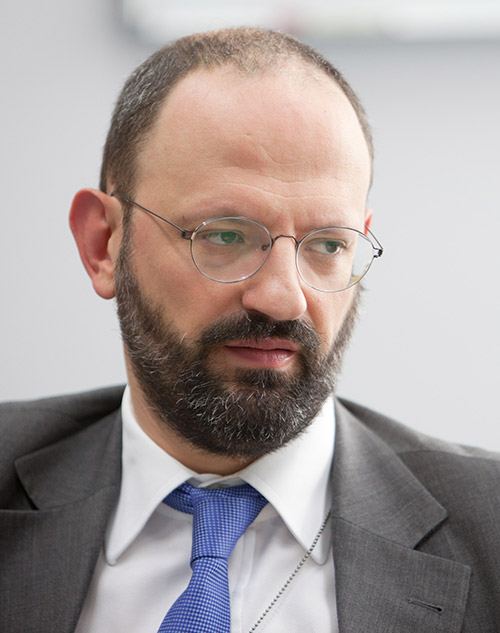
Speech by Francesco Mazzaferro, Head of the ESRB Secretariat, at the Exchange of views of the Committee on Economic and Monetary Affairs of the European Parliament
Brussels, 3 December 2025
Thank you for the opportunity to speak to you today. Digital assets represent one of the most transformative developments in the financial system of our time, offering remarkable opportunities for innovation and efficiency. However, we must remember that while technology can transform risks, it cannot eliminate them.
I will begin my remarks by referring to a recent and urgent recommendation by the European Systemic Risk Board (ESRB) in the area of stablecoins. I will then look at the future opportunities and potential risks posed by tokenisation more broadly before discussing some recent market issues with digital assets.
An urgent recommendation: mitigating risks from third-country multi-issuer stablecoin schemes
The General Board of the ESRB has recently adopted a recommendation addressing third-country multi-issuer stablecoin schemes.[1] These schemes involve EU and third-country entities jointly issuing interchangeable stablecoins.
At first sight, this would promote global integration. However, a severe stress event affecting multi-issuer stablecoins may prompt all holders to redeem from the jurisdiction offering the best redemption terms. Imagine US dollar stablecoin holders from different jurisdictions trying to benefit from the highly favourable EU redemption regime under the Markets in Crypto-Assets Regulation (MiCAR). It is highly likely that the size of the redemption requests from non-EU holders would far exceed the size of the EU issuer’s reserves. This would likely delay redemptions and, in turn, amplify runs within the EU. Furthermore, possible restrictions imposed by third-country authorities on the transfer of reserves between jurisdictions could further exacerbate our domestic liquidity issues.
Therefore, the ESRB has recommended that the European Commission clarify, by no later than the end of this year, that such schemes are not permissible under MiCAR. Let me be clear on one thing. We are not aiming for introducing any sort of ban on issuing stablecoins in foreign currency in the EU. We simply ask the Commission to clarify that stablecoins issued in the EU (whether in USD or euro) must remain separate from those issued outside the EU, and therefore must not be fungible. If the Commission does not provide that clarification and considers third-country fungibility as warranted, the ESRB, as a way of “plan B”, recommends that the EU legislator and the relevant EU and national authorities set up and implement a range of necessary safeguards, in some cases by 2026 and in other cases by 2027.
How tokenisation transforms the financial sector and systemic risks
I would now like to talk more broadly about how developments in digital assets are going to affect the way we think about financial stability.
Let me first discuss briefly the excellent report on the tokenisation of assets published by the International Organization of Securities Commissions (IOSCO) last month[2]. The report outlines how the distributed ledger technology (DLT) could impact the structure of financial markets in two very different ways, with the ultimate impact likely to combine elements of the two.
At one extreme of the range of outcomes the current structure of financial markets might remain intact. Operators in each stage of the financial cycle would adopt DLT technology and common interoperability standards. This would enable each of them to become more efficient. From a financial stability perspective, the persistent segregation of market functions would continue to mitigate conflicts of interest and foster competition.
The other extreme is that all market functions might end up being performed by a single intermediary. This would be prompted by the capacity of DLT to operate instantaneously through single commands executing multiple activities – a feature often referred to as “atomic settlement”. Assets represented on an electronic ledger – or “tokens” – could be issued, traded, sold and settled by the same intermediary, which could also provide custodial services.
Let me quote the IOSCO report: “these changes could … potentially give rise to unmanageable conflicts of interests when inherent controls in place through segregation are removed .... Concentration and competition risks can … be significantly exacerbated where investors are exposed to singular entities for the conduct of activities across the entire value chain.”
The Financial Stability Board has also considered the topic in its report entitled “The Financial Stability Implications of Tokenisation”, which was published in October last year.[3] In a world where several stages of trading activity are folded into one atomic settlement, traditional settlement risks would be radically reduced. However, they would be replaced by pervasive liquidity risks, as markets would need to function on the basis of continuous and instantaneous prefunding.
Some canaries in the coalmine?
To close my remarks today, I would like to mention some recent issues involving digital assets that warrant the attention of public and private institutions. Whether these represent “canaries in the coalmine” is a matter still up for discussion.
The first potential “canary” concerns the by-passing of audit best practices.
Some global stablecoin issuers have chosen not to apply for authorisation under MiCAR, as they are unwilling to comply with its audit requirements. Instead of conducting full audits that ensure transparency, they merely rely on attestations, the value of which for markets and authorities is less clear. It was for this very reason – i.e. issues concerning reserve disclosures – that S&P Global reduced the rating of Tether, the world’s leading (albeit non-MiCAR compliant) stablecoin provider, last week.
The second potential “canary” is related to issues with the resilience of operational frameworks.
During the recent crypto market crash in October 2025, the synthetic stablecoin USDe (which is also not authorised under MiCAR) dropped to $0.65 on Binance owing to a technical failure, despite trading near parity elsewhere. When a stablecoin trades at significant different values across platforms, it violates the principle of the singleness of money. This is the idea that one “monetary” instrument should have a uniform value regardless of where it is used.
I would like to finish by emphasising again the remarkable opportunities that the widespread adoption of digital technologies could open up, particularly in improving the speed and reducing the costs of financial services. Nonetheless, such developments must remain within the bounds of solid compliance and risk management standards, which apply regardless of the type of technology used. So, as regards preserving financial stability, the question is not whether we should adopt such technologies, but how we should do it.
Recommendation of the European Systemic Risk Board of 25 September 2025 on third-country multi-issuer stablecoin schemes (ESRB/2025/9) (OJ C 2025/6342, 21.11.2025).
The Board of the International Organization of Securities Commissions (2025), Tokenisation of Financial Assets, IOSCO, November.
Financial Stability Board (2024), The Financial Stability Implications of Tokenisation, October.
Evropská centrální banka
Generální ředitelství pro komunikaci
- Sonnemannstrasse 20
- 60314 Frankfurt am Main, Německo
- +49 69 1344 7455
- media@ecb.europa.eu
Reprodukce je povolena pouze s uvedením zdroje.
Kontakty pro média