



- SPEECH
Expanding the supply of euro safe assets
Keynote speech by Philip R. Lane, Member of the Executive Board of the ECB, at the joint workshop of the European Systemic Risk Board Advisory Technical Committee and Advisory Scientific Committee on “A European Safe Asset and Financial Stability”
Frankfurt am Main, 22 April 2026
A foundational element of any autonomous monetary system is the existence of a benchmark safe asset that serves as the anchor for asset pricing.[1] Such a safe asset should be highly liquid, so that an investor can transact in large volumes without affecting market pricing. The safe asset should also rise in relative value during stress episodes, acting as a hedge against the volatility of risk assets. By extension, it is desirable for the international monetary system that there are global safe assets that are highly liquid (directly or indirectly) and rise in currency-adjusted value during stress episodes.[2]
The current design of the euro area financial architecture results in an undersupply of euro-denominated safe assets. Since the Bund is the highest-rated large-country national bond in the euro area, it serves as the main de facto euro-denominated safe asset. However, the stock of Bunds is too small relative to the size of the euro area or the global financial system to satiate the demand for euro-denominated safe assets.
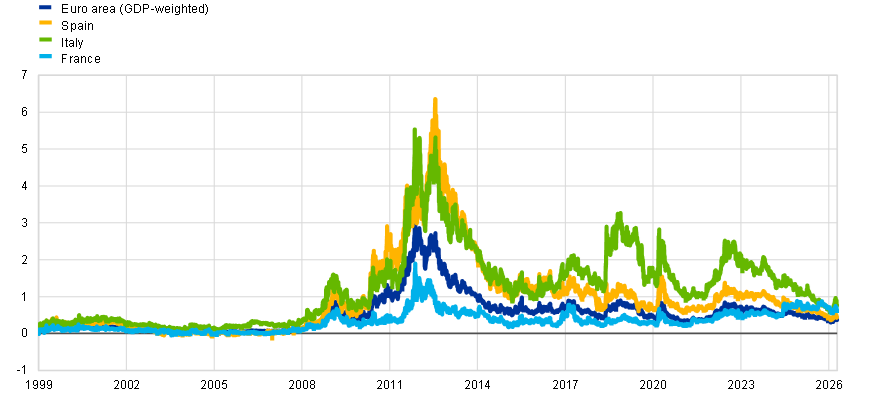
The wider universe of national sovereign bonds can also directionally contribute to the stock of euro safe assets. As illustrated in Chart 1, the role of common factors in driving the euro area bond market has increased in recent years, with much less volatility in inter-country spreads. This decline in volatility reflects a more resilient institutional structure for the euro area, underpinned by an important set of reforms in the wake of the global financial crisis and the euro area debt crisis.[3]These reforms include: an increase in the capitalisation of the European banking system; the joint supervision of the banking system through the Single Supervisory Mechanism; the adoption of a comprehensive set of macroprudential measures at national and European levels; the implementation of the Single Resolution Mechanism; the narrowing of fiscal, financial and external imbalances; the introduction of the fiscal backstops provided by the European Stability Mechanism; solidarity shown during the pandemic through the innovative Next Generation EU (NGEU) programme; the demonstrated track record of the ECB in supplying liquidity in the event of market stress; and the expansion of the ECB policy toolkit (Transmission Protection Instrument, Outright Monetary Transactions) to address a range of liquidity tail risks. However, the remaining scope for relative price movements across these bonds means that the overall stock of national bonds does not sufficiently provide safe asset services.
Chart 1
Ten-year sovereign bond spreads versus Germany
Sources: LSEG and ECB calculations.
Notes: The spread is the difference between the ten-year sovereign yields of individual countries and the ten-year yield on German Bunds. The latest observations are for 16 April 2026.
The recently announced revisions to the ECB’s EUREP repo facility also make euro-denominated assets more attractive to global investors.[4] In the context of greater geoeconomic fragmentation and uncertainty, Eurosystem liquidity facilities such as EUREP will continue to ensure the timely, consistent and broad provision of backstop funding for central banks. The updated framework will enable central banks outside the euro area to address risks of euro liquidity shortages swiftly. The provision of such liquidity lines ensures the smooth transmission of monetary policy, prevents euro liquidity shortages abroad and strengthens global trust in the euro.
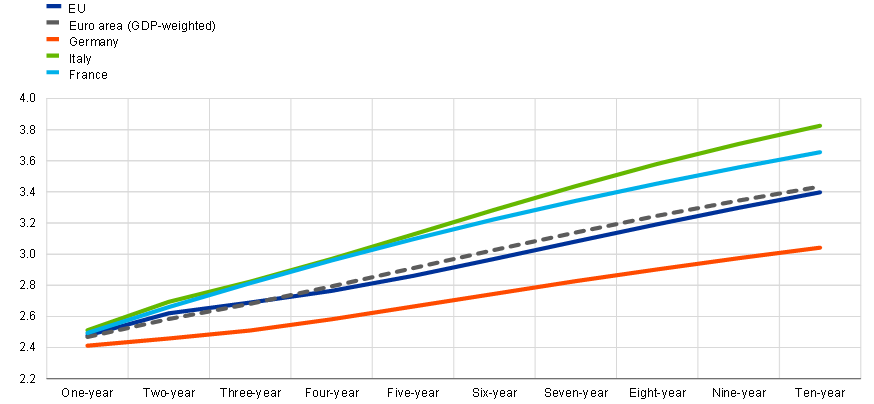
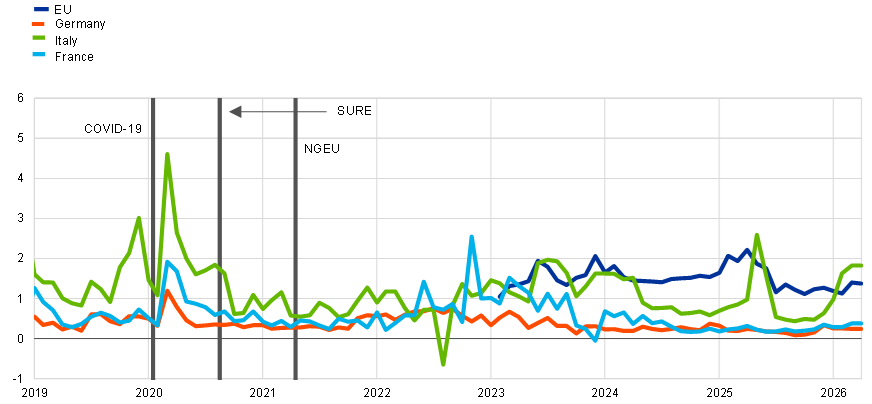
In principle, common bonds backed by the combined fiscal capacity of the EU Member States are capable of providing safe asset services. However, the current stock of such bonds is simply too small to foster the necessary liquidity and risk management services (derivative markets, repo markets) that are part and parcel of serving as a safe asset. Chart 2 shows that the pricing of EU bonds (used to fund several programmes of the European Commission such as the Support to mitigate Unemployment Risks in an Emergency (SURE) and NGEU) is broadly similar to the GDP-weighted average of national sovereign bonds. Chart 3 shows that EU-level bonds are less liquid than French or German bonds.
Chart 2
EU and sovereign yield curves
Sources: ECB calculations, Bloomberg and European Commission.
Notes: The chart shows the term structure of spot rates across euro area countries and EU bonds. The latest observations are for 16 April 2026.
Chart 3
Indicators of market liquidity
Sources: ECB calculations, Bloomberg, LSEG and European Commission.
Notes: The chart shows the time series of market liquidity (average bid-ask spreads in basis points). For individual euro area countries and the EU (European Commission), the monthly average of the bid-ask spreads of the respective benchmark bond yields is shown. The vertical lines refer to February 2020 (“COVID-19”), September 2020 (Support to mitigate Unemployment Risks in an Emergency, “SURE”) and May 2021 (Next Generation EU, “NGEU”). The latest observations are for 16 April 2026.
There are several ways to expand the stock of common bonds. Just as the NGEU programme was financed by the issuance of common bonds jointly backed by the Member States, these countries could decide to finance investment in European-wide public goods through more common debt. From a public finance perspective, it is natural to match European-wide public goods with common debt, in order to align the financing with the area-wide benefits of such public goods. In a related manner, common policy imperatives such as the urgent funding of Ukraine also warrant joint borrowing.
Outlining the general potential for greater scope for joint debt in funding joint programmes raises many governance issues, especially when the natural set of participants in a joint programme does not fully match the current membership of the EU. Accordingly, innovative forms of governance may be desirable, including taking into account the coordination of programme operation and programme funding. To this end, Philipp Hildebrand, Hélène Rey and Moritz Schularick have recently developed a set of principles that jointly address how European countries could expand shared defence capabilities and develop a common framework for their financing.[5] Over time, the associated joint debt could make a sizeable contribution to the expansion of euro safe assets.
In addition, in order to meet the rising global demand for euro-denominated safe assets more quickly and decisively, there are a number of options to generate a larger stock of safe assets from the current stock of national bonds. For instance, Olivier Blanchard and Ángel Ubide recently proposed that the “blue bond/red bond” reform be re-examined.[6] Under this approach, each member country would ring-fence a dedicated revenue stream (a certain amount of indirect tax revenues, for example) that could be used to service commonly issued bonds. In turn, the proceeds from issuing blue bonds would be deployed to purchase a given amount of the national bonds of each participating Member State. This would result in a larger stock of common bonds (blue bonds) and a lower stock of national bonds (red bonds).
As emphasised in the Blanchard-Ubide proposal, there is an inherent trade-off in the issuance of blue bonds. A larger stock of blue bonds would boost liquidity and, if critical mass is attained, would also trigger the fixed-cost investments needed to build out ancillary financial products such as derivatives and repos. However, too large a stock of blue bonds would require national tax revenues to be ring-fenced on a scale that would be excessive in the context of the current European political configuration, in which fiscal resources and political decision-making primarily remain at the national level. As emphasised in the proposal, this trade-off is best navigated by calibrating the stock of blue bonds at an appropriate level.
In particular, the Blanchard-Ubide proposal gives the example of a stock of blue bonds corresponding to 25 per cent of GDP. To illustrate the scale of the fiscal resources required to back this level of issuance, if bond yields were in the range of 2 to 4 per cent on average, the servicing of blue bond debt would require ring-fenced tax revenues in the range of 0.5 to 1 per cent of GDP. While this would constitute a significant shift in the current allocation of tax revenues between national and EU levels, it would still leave tax revenues predominantly at the national level (the ratio of tax revenues to GDP in the euro area ranges from around 20 to 40 per cent). The shared pay-off would be the reduction in debt servicing costs generated by the safe asset services provided by an expanded stock of common debt.
An alternative and possibly complementary approach that could also deliver a larger stock of safe assets from the pool of national bonds is provided by the sovereign bond-backed securities (SBBS) proposal.
This proposal envisages that financial intermediaries (whether public or private) could bundle a portfolio of national bonds and issue tranched securities, with the senior slice constituting a highly safe asset. The SBBS proposal has been studied extensively (I chaired an ESRB High-Level Task Force on Safe Assets that published a report in January 2018), and draft enabling legislation was published by the European Commission.[7] Just as with the blue/red bond proposal, sufficient issuance scale would be required in order to foster the market liquidity needed for the senior bonds to act as highly liquid safe assets.
In summary, there are several complementary routes to expand the stock of common euro debt and thereby help to meet the demand for euro-denominated safe assets. I have focused on proposals that are potentially feasible, constituting incremental steps that build on the current institutional configuration. Further progress in expanding the stock of joint debt in Europe ultimately depends on sufficient political will and mutual trust.[8] This includes full and shared recognition that the safety of common debt relies on the robust and demonstrable commitment of all Member States to maintain sustainable national debt paths: an expansion of common debt increases the importance of fiscal discipline at the national level.
Finally, an expanded stock of euro safe assets would provide the foundations for a more general increase in global demand for euro-denominated assets by providing essential liquidity and hedging services. In turn, this would reinforce the gains from pro-growth economic policies that would increase the size and profitability of European firms, thereby increasing the incentives to issue and hold corporate securities. As laid out in the Draghi and Letta reports, a concerted campaign to increase the pan-European integration of product markets would not only contribute to a faster growth rate but would also enable more firms to expand to the scale at which market-based financing becomes a more viable option.[9][10] By lowering transaction costs, improving liquidity and increasing domestic demand for the full spectrum of financial assets, the savings and investments union package of measures (reinforced by further progress on banking union) can further boost the scale and efficiency of the European financial system. For these reasons, there are strong complementarities between an expansion in the supply of euro safe assets and the overall success of the savings and investment union initiative.
This speech draws on the discussions in Lane, P.R. (2025), “The euro area bond market”, keynote speech at the Government Borrowers Forum 2025, Dublin, 11 June and Lane, P.R. (2026), “The euro in a changing world,” keynote speech at the Danish Economic Society Conference, Kolding, 9 January.
Indirect liquidity refers to the scope to use the safe asset to tap available liquidity facilities, such as the ECB’s swap lines or its EUREP repo facility. An asset rises in currency-adjusted terms if, from the perspective of the foreign investor, the combined impact of the domestic currency asset price movement and the exchange rate movement during a stress episode means that the foreign investor enjoys an increase in the foreign currency relative value of the asset.
See also Lane, P.R. (2021), “The Resilience of the Euro”, Journal of Economic Perspectives, Vol. 35, No 2, pp. 3-22.
For the details, see ECB (2026), “ECB enhances repo facility for central banks”, press release, 14 February.
Hildebrand, P., Rey, H. and Schularick, M. (2025), “European defence governance and financing”, VoxEU, 20 November.
Blanchard, O. and Ubide, Á. (2025), “Now is the time for Eurobonds: A specific proposal”, Peterson Institute for International Economics, 30 May.
See ESRB High-Level Task Force on Safe Assets (2018), “Sovereign bond-backed securities: a feasibility study – Volume 1: main findings”, European Systemic Risk Board, January; Brunnermeier, M.K. et al. (2016), “The Sovereign-Bank Diabolic Loop and ESBies”, American Economic Review, Vol. 106, No 5, pp. 508-512; Brunnermeier, M.K. et al. (2017), “ESBies: safety in the tranches”, Economic Policy, Vol. 32, No 90, pp. 175-219; van Riet, A. (2017), “Addressing the safety trilemma: a safe sovereign asset for the eurozone”, Working Paper Series, No 35, European Systemic Risk Board; De Sola Perea, M., Dunne, P.G., Puhl, M. and Reininger, T. (2019), “Sovereign bond-backed securities: A VAR-for-VaR and marginal expected shortfall assessment”, Journal of Empirical Finance, Vol. 53, pp. 33-52; Cronin, D. and Dunne, P.G. (2019), “How effective are sovereign bond-backed securities as a spillover prevention device?”, Journal of International Money and Finance, Vol. 96(C), pp. 49-66; Dunne, P.G. (2019), “Positive liquidity spillovers from sovereign bond-backed securities”, Journal of Risk and Financial Management, Vol. 12, No 2; and Alogoskoufis, S. and Langfield, S. (2020), “Regulating the Doom Loop”, International Journal of Central Banking, Vol. 16, No 4, pp. 251-292.
See also Dorrucci, E. and Rossi, S. (2026), “Towards a next generation of joint borrowing in Europe”, Perspectives on Federalism, Vol. 17, No 2, Fondazione CSF.
Draghi, M. (2024), The future of European competitiveness, September.
Letta, E. (2024), Much more than a market, April.
Banco Central Europeu
Direção-Geral de Comunicação
- Sonnemannstrasse 20
- 60314 Frankfurt am Main, Alemanha
- +49 69 1344 7455
- media@ecb.europa.eu
A reprodução é permitida, desde que a fonte esteja identificada.
Contactos de imprensa